Discover −34%: Rented Reach Is Not a Business Model
6 min read

About the author: Stephanie Schuricht is Head of Audience Development at beatsquares, where she is building up the Growth team. Previously, she led Audience Development at Bauer Xcel Media in Hamburg for brands such as "Bravo", "TV Movie" and "Lecker", having served there as Head of SEO before that. She brings more than ten years of experience in SEO, e-commerce and performance marketing. LinkedIn
Google Discover traffic is collapsing for many publishers because Google is rebuilding the feed and penalizing old tricks like republishing. With clear topical authority, Discover can still be played. But you cannot plan a business on it, because Google sets the rules.
During my time as Head of Audience Development, I watched Discover traffic drop by around a quarter within a short period across several brands at once, and for some it disappeared entirely. The brands hit hardest were the ones most dependent on Discover.
The reasons were no secret: frequency, quality and the good old republishing tricks that no longer worked or even did harm.
What is happening to Discover traffic right now?
I am not alone in this observation. In June, Jan Freynick, CMO of beebuzz media, took part in a WebSession by the MVFP Akademie. His company grew strongly with Discover for years. Since early April, he reported, a lot has shifted again: evergreen content and classic republishing have a much harder time getting into the feed. The genuine news business has remained fairly stable. Tools like browser push, which used to give Discover a boost, no longer work the way they once did.
This matches what Google itself has announced. In February 2026, the first core update for Discover alone was rolled out. It is meant to strengthen locally relevant content and genuine topical authority and to push back clickbait, as SISTRIX notes in its monthly review.
And it matches the numbers. Across the network of analytics provider Chartbeat, Discover traffic fell by 34.3 percent from July 2025 to July 2026, compared with 6.6 percent the year before (Chartbeat Publisher Playbook 2026). The network includes media companies in more than 70 countries; Chartbeat does not report a separate figure for Germany.
Why are some brands hit harder than others?
Brands that relied too heavily on mixed topics, meaning celebrity news plus household tips plus recipes plus DIY and more, could no longer establish authority. I have seen this myself.
Jan Freynick told a similar story in the WebSession. His team transferred its own Discover recipes to an acquired second platform, with the same authors covering the same topics. It did not work.
Does that mean Discover is a write-off?
No.
Moritz Serif, an SEO consultant for publishers, pushed back in the same session: Discover becomes predictable when a newsroom publishes strictly along the topics for which Google rates it as an authority. He illustrated this with a client example. I would sign off on that.
The situation in Germany is also friendlier than the headlines from the US suggest. According to a benchmark by Mather Economics, German news brands grew their visitors by 7.8 percent in the second quarter of 2026, and independent regional publishers even by 30.9 percent. The losers were the large portals and mass-market brands, at minus 6.5 percent.
Mather cautiously attributes this to reader loyalty and habit. In other words, the winners are the publishers whose readers come back on their own.
Why is rented reach still not a business model?
Because Google makes the rules.
In the US, Brazil and Mexico, the Discover feed now consists of 51 percent AI summaries. In the US, clicking on one plays a YouTube video in 77 percent of cases instead of leading to a publisher's site. That is shown by an analysis from Marfeel. The feed in German-speaking countries still looks different today. But Marfeel expects the overhaul to reach Europe as well.
Google also decides the pace. Discover for desktop has been announced since spring 2025. Nobody knows when it will actually arrive.
In classic search, the shift is already measurable. When an AI Overview appears in Germany, the click-through rate for the first organic position drops from 27 to 11 percent, according to SISTRIX. And AI services send hardly anyone onward: in the Chartbeat network, they account for 0.01 percent of traffic.
Jan Freynick drew a conclusion from this that I have rarely heard from a publisher. Monetizing reach the classic way no longer works, he said. Publishers have made themselves dependent on Google and need to get off that dependency again, towards a community they own themselves.
What do you really own? Newsletters, WhatsApp and your own ecosystem
It is impossible to predict with certainty where Discover and similar channels are heading. Strengthening relationships through channels like WhatsApp or newsletters and repeatedly bringing readers back into your own ecosystem is simply subject to fewer fluctuations.
The Chartbeat data supports this. While Google Search's share of page views fell from around 9 to 5 percent, the traffic that publishers control themselves grew from July 2024 to July 2026: direct visits from 13.5 to 15.9 percent, internal clicks from 37.9 to 40.4 percent, and so-called dark social from 7.1 to 11.3 percent.
Dark social refers to links that people share privately, via WhatsApp, direct message or email. The channel is called "dark" because analytics tools cannot see where these clicks come from. Behind them are readers who find an article good enough to send to someone personally. Overall reach remained almost stable on average: 31.1 billion page views per month from January to July 2026, after around 32 billion in 2025.
It becomes even clearer with loyal readers. According to Chartbeat, 51 percent of their page views come via internal clicks and 24 percent directly. Only 3 percent come via Google Discover.
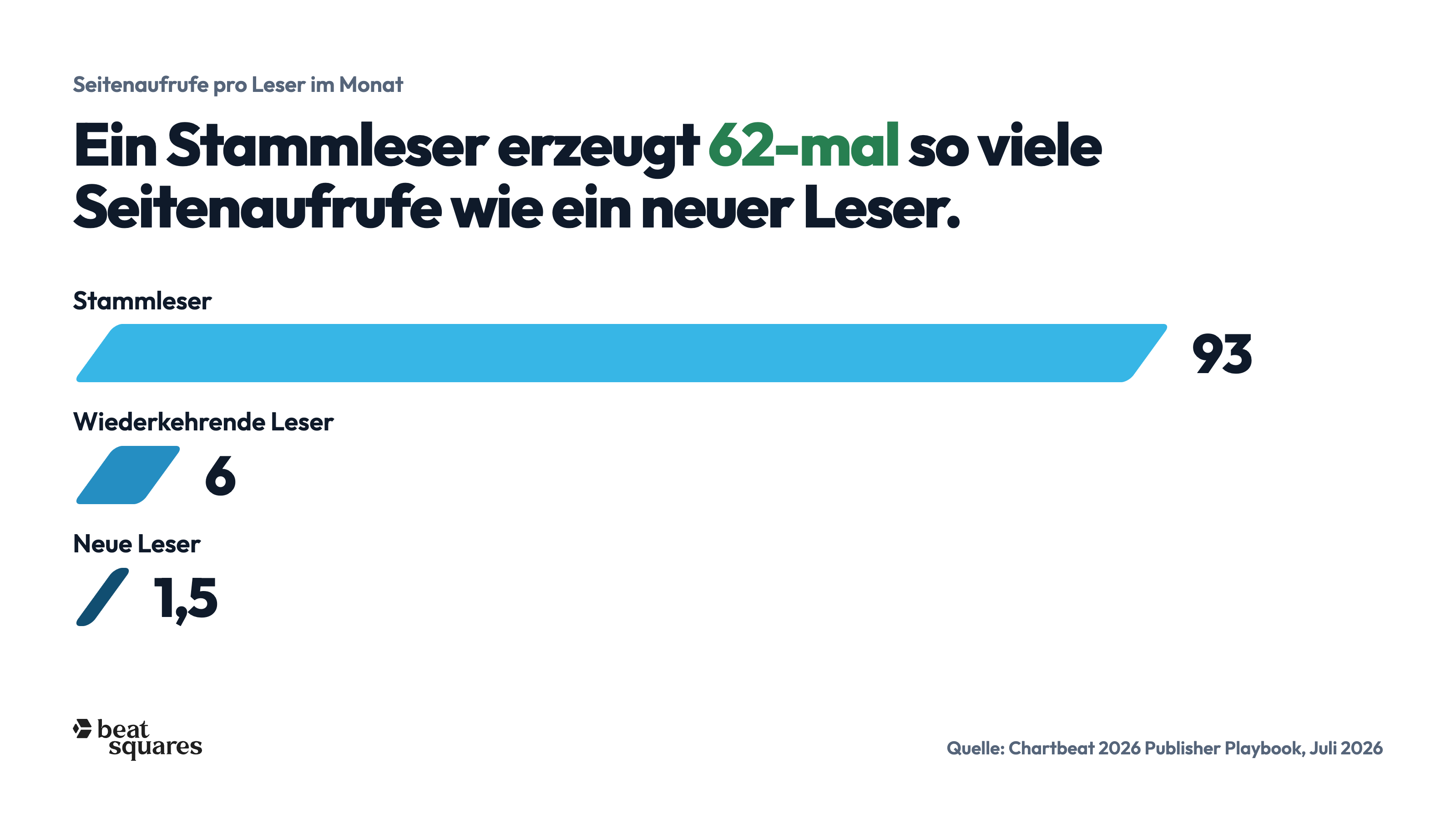
In the Chartbeat network, a loyal reader generates 93 page views per month, a new reader 1.5. That is 62 times as many.
Owned channels and Discover are not mutually exclusive. Moritz Serif reported on a client with a six-figure number of newsletter subscribers. Every send there also gives Discover a fresh boost. So if you reach your readers directly, you send exactly the signals the feed rewards.
At beatsquares, we build such channels with publishers, from newsletters to WhatsApp channels.
What does this mean for the newsroom?
Three things I would tackle earlier today:
- Set topic priorities. The newsroom and content directors decide together what the brand stands for. Don't shoot in every direction hoping something will stick.
- Make expertise visible and end republishing routines. What used to bring reach can do harm today.
- Take an owned channel seriously. Newsletter or WhatsApp, and then regularly bring readers back into your own ecosystem.
Discover remains a good channel for publishers who know what they stand for. It is not a business model, because the landlord can renovate at any time.
If you'd like to see what owned channels can look like for publishers and media companies, book a demo.
And now I'm curious about your view: How many loyal readers do you have?