
Liquid Content: How Newsrooms Scale Across Channels with AI
7 min read
About the author: René Bosch is co-founder and CEO of beatsquares. He was previously deputy editor-in-chief of Bild, after heading Editorial Analytics for Bild and Welt at Axel Springer. LinkedIn.
A short news podcast in the car in the morning, a WhatsApp message about the new school bus schedule at lunchtime, an in-depth analysis in the newsletter in the evening. This is how people consume journalism today: on the channel of their choice, in the format that suits them, at the right moment. Liquid content is how newsrooms meet that expectation.
What Is Liquid Content? A Definition
Liquid content is journalism that is not tied to a fixed format. A single piece of reporting becomes the right format for every audience, every channel and every moment: from newsletters and podcasts to WhatsApp channels. For day-to-day newsroom work, the term can be defined like this:
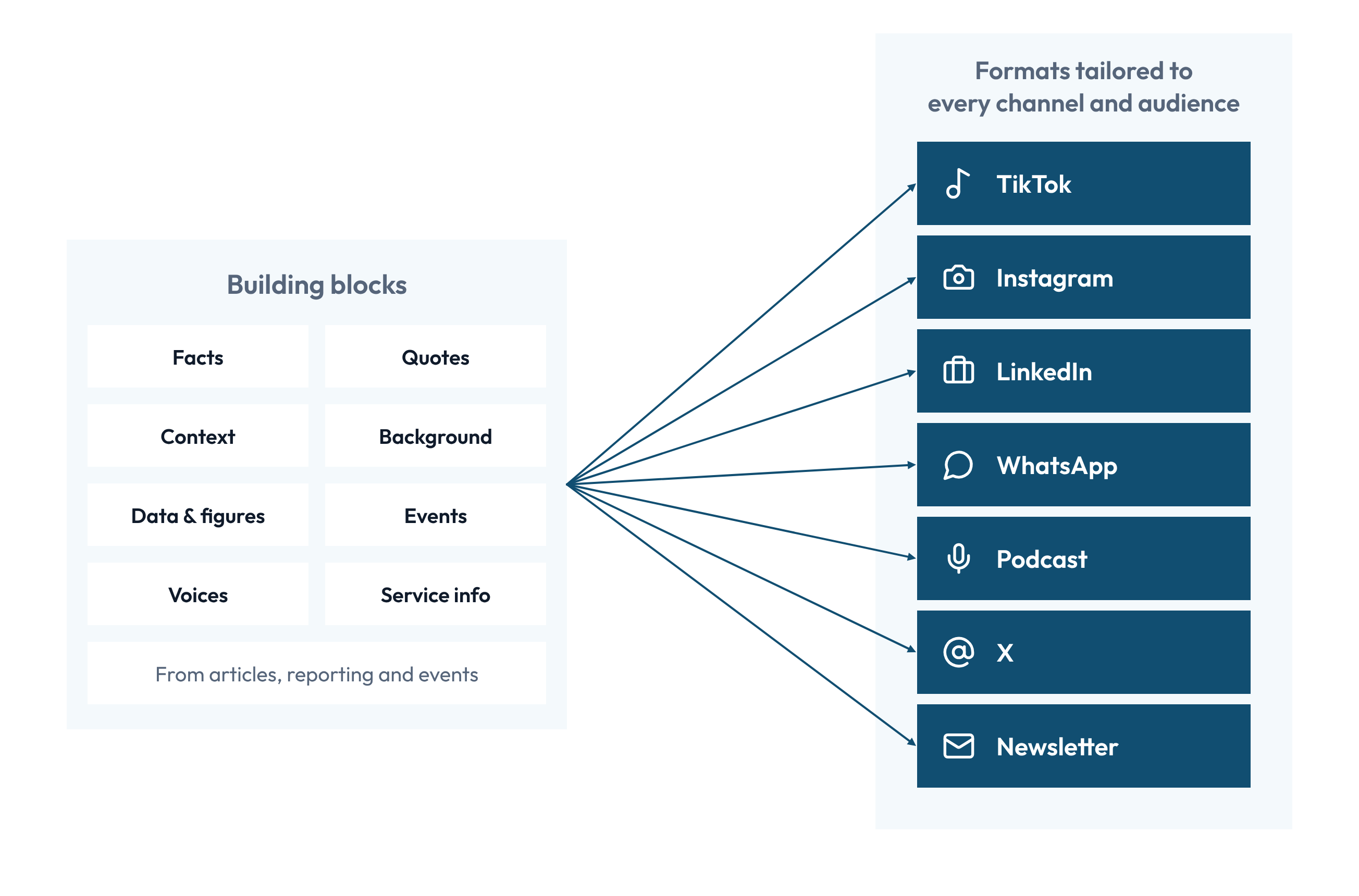
Liquid content is journalistic knowledge held in building blocks: facts, quotes, context and background. From these, formats of the right shape, length and depth are created for each audience, channel and moment.
[INSERT GRAPHIC HERE: liquid-content-building-blocks-formats.png · Alt text: Liquid content: journalistic building blocks such as facts, quotes, context and background become formats tailored to every channel and audience, from TikTok, Instagram, LinkedIn and WhatsApp to podcasts, X and newsletters.]
The opening example shows how it works. The district council reroutes a bus line. The reporting delivers the facts (route, times, stops), the context (costs, the council debate) and a quote from the district administrator. That becomes two sentences in the morning news podcast for commuters, an alert about the new school bus time in the WhatsApp channel for parents, and the full analysis in the newsletter.
The knowledge is gathered once and used many times. We call this Return on Research: every piece of reporting reaches far more people than a single article ever could.
The Reuters Institute counts the approach among the defining developments of 2026. In a survey by the German trade magazine kress pro, almost all media companies rated liquid content as highly relevant.
The Problem: The Article as a Bottleneck
Reporting is expensive. Interviews, documents, site visits, fact-checking. In most cases, the result is a single article, which ties all of that knowledge to one format.
Audiences, however, are spread across many channels. According to the Digital News Report 2026 for Germany, 23 percent of respondents use WhatsApp for news every week. 15 percent regularly get news by newsletter or email. Eight percent listen to news podcasts. For 44 percent of 18- to 24-year-olds, social media is their main source of news.
Serving each of these channels by hand takes more staff, and most publishers cannot afford that. The answer is not more headcount but a different way of working. This is where liquid content comes in.
Liquid Content vs. Repurposing: What's the Difference?
Liquid content is often equated with content repurposing. Both bring content to multiple channels, but they start in very different places.
| Repurposing | Liquid content | |
|---|---|---|
| Starting point | The finished article | The knowledge behind the article: facts, quotes, context, background |
| Process | The text is rewritten for each channel after publication, usually by hand | All formats are created from the same foundation and approved by the newsroom |
| Audience | Everyone, no specific audience | A specific audience with its own questions |
| Effort | Grows with every additional channel | Barely grows, even across many channels and audiences |
| Result | A shortened version of the same article | A dedicated product for each audience |
How Liquid Content Works in the Newsroom
Many newsrooms worry that they will have to replace their CMS. They don't. Liquid content builds on existing systems. The process has four steps.
1. Connect sources. The newsroom decides which material formats are created from: published articles, its own newsletter, event listings, press releases or public documents from city hall and the district office. Familiar workflows stay in place.
2. Select for an audience. The newsroom decides what matters to which audience. Parents need different information than commuters. This curation is the heart of the process.
3. Generate formats. The software combines the relevant content and writes it in the brand's own voice for each channel: short for mobile, spoken for audio, in depth for the newsletter.
4. Approve. Nothing is published unchecked. The newsroom sees every version, adjusts it where needed and approves it.
As the newsroom gains experience, it can connect individual building blocks instead of whole texts, such as the key facts of a decision, a quote or a figure.
Why Liquid Content Pays Off for Publishers
Niche audiences become viable. A dedicated WhatsApp channel just for parents or a podcast for commuters has rarely been sustainable. The effort per edition was too high. With liquid content, it drops so far that hyperlocal and topic-specific products pay off.
Independence from platforms. Relying on one channel means relying on its rules. When a platform changes its algorithm, reach disappears. With liquid content, journalism flows to wherever the audience is right now. Instagram today, a new channel tomorrow. The foundation stays the same.
More time for journalism. Summarizing, shortening and reformatting take up hours every day in many newsrooms. The software takes over this routine work. The time saved goes into exclusive reporting and original stories, which strengthens the journalistic brand.
Liquid Content in Practice: Examples from German Newsrooms
German media companies already use liquid content every day.
Walsroder Zeitung, a local newspaper in Lower Saxony's Heidekreis district, turns its local coverage into several products every day. Commuters listen to a short news update as a podcast in the car each morning. Parents get what matters for children and families in the district straight to their phones via a WhatsApp channel. Readers who simply want to stay informed receive the day's news in a newsletter or on WhatsApp. On Instagram, posts appear as needed about what moves the people of the Heidekreis.
Liquid content is especially strong in hyperlocal journalism. The Berlin daily Der Tagesspiegel uses beatsquares to produce its district newsletters for all twelve Berlin boroughs. Each edition takes around 30 minutes instead of three hours. Süddeutsche Zeitung runs ten regional WhatsApp channels with beatsquares. Doing this by hand at consistent quality would hardly be possible.
Quality and Control: The Newsroom Has the Final Say
Technology must not compromise journalistic standards. Used well, it strengthens them.
All formats draw on the same foundation. The facts are therefore identical everywhere; only the selection, emphasis and explanation differ. Statements are automatically checked for accuracy against the sources. And no version is published until the newsroom has approved it.
Responsibility stays with people. That is how a newsroom carries the credibility it has built over years onto every new channel.
Where Your Newsroom Can Start
Getting started is manageable. It begins with an audience you don't reach well enough today and a channel where that audience spends its time. Add the sources the product will be built from and a clear approval process. After a few weeks, you will see how much time it saves and how the audience responds.
Our guide In 5 Steps to a Liquid Content Newsroom walks you through the process step by step.
Conclusion
Liquid content is more than a trend. It is the answer to a fragmented audience. Newsrooms free their knowledge from the rigid article and turn it into formats for every audience.
Those who start now become independent of individual platforms and reach people where they actually are.
Want to see what this looks like with your own content? Request a demo. Learn more about our solutions: beatsquares for publishers and media companies.
Frequently Asked Questions About Liquid Content
What is liquid content in simple terms? Liquid content is journalism that is not tied to a single format. From the same reporting, a newsletter, a podcast, a WhatsApp message or a long-form article is created, depending on the audience, channel and moment.
What is the difference between liquid content and repurposing? Repurposing rewrites a finished article after publication, usually by hand. Liquid content starts from the knowledge behind the article and creates formats for specific audiences, which the newsroom approves.
Do I need a new CMS for liquid content? No. Liquid content builds on existing systems. To get started, it is enough to connect existing sources such as articles, newsletters or event listings.
Which newsrooms is liquid content suitable for? Any newsroom that wants to reach more audiences on more channels without adding staff. Regional and local newsrooms with many small audiences, such as individual neighborhoods or districts, benefit the most.
Sources
- Reuters Institute: Journalism, media and technology trends and predictions 2026 (January 2026)
- kress: Liquid Content: Warum der nächste große Medientrend einen Haken hat (May 8, 2026, in German)
- AVS: Liquid Content: Der Megatrend, der Verlage näher an ihre Leser bringt (August 25, 2026, in German)
- Der Tagesspiegel: Mehr Zeit für exklusive Recherchen (July 16, 2026, in German)
- beatsquares for publishers (as of November 5, 2026)
- Hans-Bredow-Institut: Reuters Institute Digital News Report 2026, results for Germany (June 2026, in German)