
Introducing Liquid Content: 6 Steps to a Liquid Content Newsroom
10 min read

About the author: Jaqueline Frank is an Editorial AI Specialist at beatsquares. She helps newsrooms introduce liquid content, from the first conversations about audiences and tone to the first issue.
Newsrooms that introduce liquid content are responding to a clear expectation. People today want news where they already are: in a WhatsApp channel, in a newsletter or in a podcast on the way to work. Doing that by hand for every audience is hardly feasible. Liquid content turns the articles and research a newsroom has already produced into the right offering for each audience. This guide shows in six steps how a newsroom becomes a liquid content newsroom. It is written for editors-in-chief and for everyone who wants to move liquid content forward in their own organization.
Before you start: what introducing liquid content means
Liquid content means that a newsroom's articles and research become formats tailored to each audience, on the right channel and at the right time. Our introductory article Liquid Content: How Newsrooms Scale Across Channels with AI explains what is behind it.
For the introduction, one thing matters most: liquid content concerns the entire newsroom. The goal is for all of its editorial work to benefit all of its audiences, from published articles to research that never quite made it into a story. That is where the real value lies. A lot of work goes into these articles and this research, and with liquid content they reach people who would never have read them otherwise. The result is a content ecosystem in which newsletters, WhatsApp channels, podcasts and social media formats are all fed by the same editorial work. The following steps therefore apply to every audience and every format.
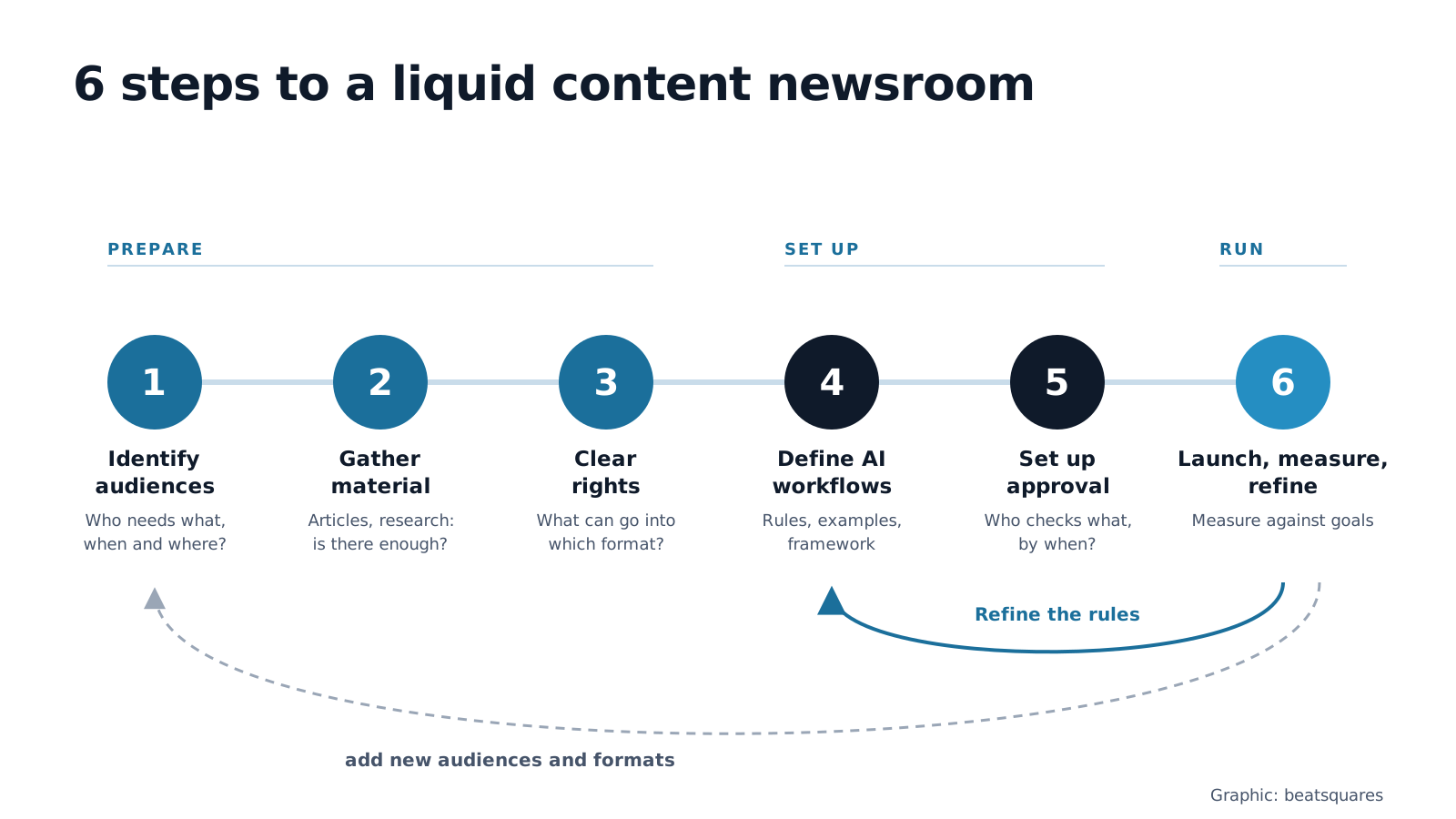
Step 1: Identify your audiences
When newsrooms think about liquid content, many think of a new channel first. The better order is: people first, then their needs, then the format. That is why two questions come at the start. Which audiences are there, and what should they know?
Where to find your audiences
The answers are often already in-house. Usage data shows who reads which articles, at what time and on which device. Subscription and newsletter data shows which topics keep people engaged. Letters to the editor, comments and reader questions reveal which questions remain unanswered. Local reporters usually know the groups in their area first-hand, and sales and advertising teams know them from conversations with customers. What matters to an audience shows most clearly in what it already reads and what it asks about.
Four questions for every audience
Every audience can be described with four questions:
- Who? A group in a shared situation, such as parents of schoolchildren in the district.
- What? What information does this group need again and again?
- When? When does the group consume news: at what time of day, on which weekday, in which season or on which occasion? Parents read before school starts, families plan their weekend on Thursdays, and a holiday resort needs different topics in summer than in winter.
- How? In which format and on which channel?
Today, audiences are spread across many channels. According to the Digital News Report 2026, 23 percent of respondents in Germany use WhatsApp for news every week. Typical audiences include parents who want to know early in the morning whether the school bus is running, commuters who need traffic jams and train cancellations, and local businesses that want to read the council's decisions of the week every Monday.
Measurable goals for every audience
Before launch, each audience gets a definition of what success looks like:
- Should production time per issue go down?
- Should a new audience be reached, measured in subscribers or followers?
- Should a new subscription or advertising product be created?
- Should more people click through to the newsroom's own articles?
Step 2: Connect articles, research and other sources
The most important material is the articles a newsroom publishes anyway, and the research behind them. A lot of work goes into them, and they often hold more than a single story shows. A report on a council meeting, for example, provides the update for the parents' channel, the figure for the business newsletter and the date for the weekend roundup. All kinds of sources can be connected.
Your own research and external sources
The material includes:
- published articles and the archive
- your own research, appointments and notes, as far as they may be used
- press releases from companies, police and associations
- public documents from the town hall, the district office and the council information system
- event calendars, clubs, chambers and associations
How articles and research get into the database
Articles are connected via the CMS, an RSS feed or the e-paper and then flow in automatically. Research and notes can be added as documents. AI breaks articles and documents down into chunks, the so-called building blocks of liquid content. This creates a database of the newsroom's work in which the right material can be found for every audience. With curation for every audience, beatsquares selects what fits which audience.
Step 3: Clear the rights
Not everything that is technically available may appear in new formats. Photos and texts from news agencies such as dpa, contributions from freelancers and quotes from interviews may be tied to specific uses. That is why the legal department clarifies which material may be used in newsletters, podcasts or WhatsApp.
In day-to-day work, it helps when every statement shows which source it comes from and only sources the newsroom has selected itself are used. Restrictions can also be set as fixed rules in the AI workflow, for example that news agency texts are only linked and never copied.
Step 4: Define AI workflows for every format
Every format needs its own AI workflow. It defines how the material becomes a finished issue: which content is selected, how it is prepared and in what form it is published. A newsletter for parents sounds different from a podcast for commuters, and a WhatsApp channel needs shorter texts than a weekly review. At the same time, every issue should sound like your own newsroom. The workflow is set up once per format and refined later during operation (step 6). From then on, issues follow the same pattern every time and only need approval at the end.
Much of what defines a newsroom is not written down anywhere. AI does not know these preferences unless someone spells them out. That is why they are gathered in a conversation with the newsroom and recorded as rules: tone and stance, forms of address and spelling, topics and no-gos, such as a place name the newsroom deliberately no longer uses. Added to this are sample texts that show what an ideal issue looks like. For an existing newsletter, previous issues serve as the template. These examples later become the benchmark for whether the results fit.
Finally, the workflow sets the framework: channel and audience, structure and length, sources, publishing frequency and the parts that deliberately stay handmade, such as a personal editorial.
Take a WhatsApp channel for parents. It goes out at 6:45 a.m. on school days, addresses parents informally, starts with cancelled lessons and contains no more than three updates. Updates in which individual children could be identified are off-limits. A few issues written by hand in advance by an editor serve as the benchmark. From then on, the channel is created every morning according to these specifications.
How it works at beatsquares: the harness
At beatsquares, all workflows run within a fixed framework, the so-called harness. It defines the steps a text goes through before the newsroom sees it: selecting content, writing, checking facts against the source and matching the newsroom's rules. The rules, examples and framework of each format build on top of it.
The newsroom receives finished drafts in which every statement is backed by its source. The texts follow the rules of the format and adapt over time to the style of the newsroom and of individual authors. The results stay reliable even though they are created automatically, and the newsroom only has to make a few corrections. Learn more at beatsquares for publishers and media companies.
Step 5: Set up approval
No text is published without approval. Before launch, the newsroom therefore defines:
- Who edits the issue, and who approves it?
- By when does approval have to happen for the format to go out on time?
- What is checked: facts against the source, selection, tone?
- Who steps in when someone is away?
The process itself is short. An editor edits the issue and passes it on, an editor-in-chief proofreads it and approves it with one click. In beatsquares, statements are automatically checked against the source, and the newsroom sees every variant before it is published.
Step 6: Launch, measure, refine
Once the process is set up, the first issue goes out, such as the first newsletter for parents. At beatsquares, this usually takes one week from the start of the introduction.
Every format is measured against the goals from step 1. Just as revealing is what the newsroom changes in the drafts, because recurring corrections show where a rule is missing or imprecise.
A cycle that keeps learning
At beatsquares, this has become a self-learning cycle. Changes the newsroom makes to the drafts are evaluated regularly. They lead to suggestions for new or adjusted rules, which are only adopted after the newsroom has reviewed them. With every round, the texts come closer to the style of the newsroom and its individual authors.
This can be seen clearly at Tagesspiegel. beatsquares supports the district newsletters for Berlin's twelve districts there. Each format learns from the changes its editors make, and as a result the drafts come closer to their own style week by week.
More formats keep emerging from the same material, such as a podcast based on the newsletter. New audiences are added following the same steps.
Where liquid content reaches its limits
Liquid content gets more out of editorial work. Whether it also helps a newsroom reach its own goals depends on further factors:
- The newsroom decides on formats. It decides which editorial content appears where and in what form.
- Human in the loop is still wanted. Many newsrooms want to see every text before it is published, and rightly so. Once the legwork is done, the newsroom only has to sign off, and the content goes out on every channel, tailored to each audience.
- Efficiency requires a fixed framework. Liquid content only saves time if a harness captures the newsroom's rules and makes every text reliable and professional. This is where beatsquares comes in.
Conclusion
Introducing liquid content is first and foremost an editorial decision: who the newsroom works for and what it makes of its articles and research. At the same time, it is a decision about how the newsroom works. Liquid content only becomes efficient when the legwork runs automatically and the newsroom can focus on research, selection and approval. That requires a system that knows the newsroom's rules, checks every statement against its source and learns from the newsroom's changes.
That is exactly what beatsquares is built for. A newsroom's editorial work becomes a content ecosystem in which every audience gets what it needs. The newsroom always has the final say on every text.
Want to see what this looks like with your newsroom's content? Request a demo.
Frequently asked questions about introducing liquid content
Do I need a new CMS for liquid content? No. With beatsquares, liquid content builds on your existing systems. Articles, building blocks and external sources are connected, and the newsroom keeps working in its familiar workflows.
How long does it take to introduce liquid content? The first issue usually goes out within one week. After that, the formats are refined during operation.
How do I identify my newsroom's audiences? The same questions apply to every group: Who are these people, what information do they need, when and on which channel? Typical audiences include parents, commuters and the local business community. Groups that a newsroom hardly reaches today, even though it has plenty of material for them, are especially worthwhile.
Sources
- Hans-Bredow-Institut: Reuters Institute Digital News Report 2026, results for Germany (June 2026)