AI Media Leaders Conference 2026: Recap
9 min read

AI Media Leaders Conference 2026: Journalism has to travel. Just not everywhere at once.
In short: Publishers don’t need to be on every channel right away. It makes more sense to start with a few channels that build loyalty and that your audience actually uses. That is my conclusion from the AI Media Leaders Conference 2026 in Hamburg, which produced three findings: the middle of the media market is hollowing out, journalism has to be able to travel across many channels, and hardly any publisher can yet put a number on the value of liquid content. On 12 November 2026, nextMedia.Hamburg hosted the AI Media Leaders Conference for the second time, this year at Emporio Haus in Hamburg. What impressed me most were the insights the guests from the UK and the US brought with them. I took notes, took photos and sat in a roundtable where almost no hands went up when the decisive question was asked.
What is happening to the middle of the media market?
David Caswell, a consultant and former Executive Product Manager at BBC News Labs, brought an image that has stayed with me: a barbell. One end is what he calls the “luxury market”, the other the “commodity market”. Above the bar between them was one sentence: “The middle hollows out.”
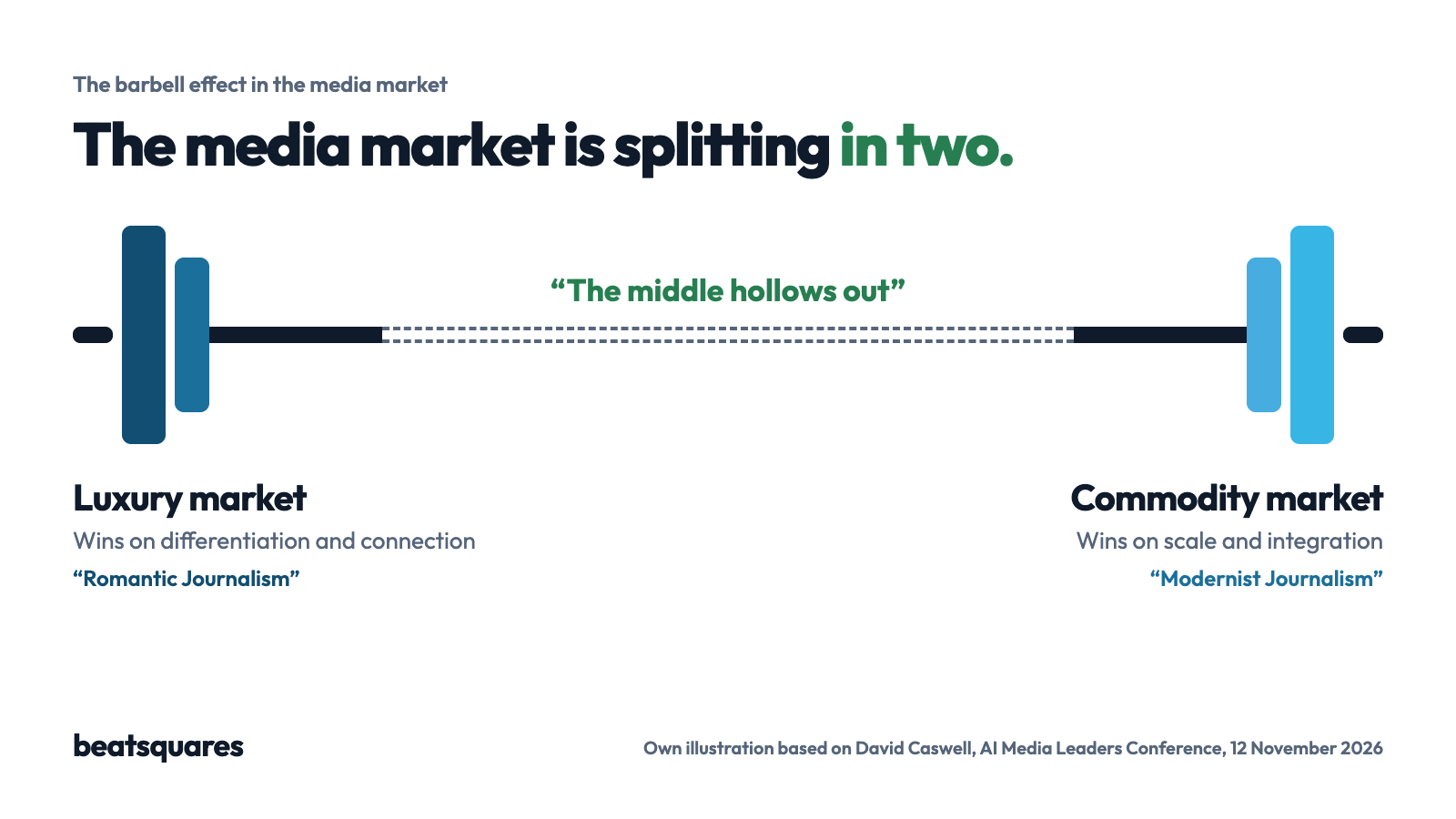
Credit: Own illustration based on David Caswell, AI Media Leaders Conference
The commodity side wins on scale and integration. It follows what his slide gave as the motto of “Modernist Journalism”: whatever can be automated will be automated. The luxury side wins on differentiation and connection. There is now a name for this, “Romantic Journalism”, which Lea Korsgaard of Zetland and Joshi Herrmann of Mill Media presented as a manifesto in Perugia in April. Rasmus Kleis Nielsen set the two attitudes side by side in the summer.
Caswell’s next slide said that the romantic side is no natural home for institutions: traditional media companies compete there with machines and, at the same time, with creators who use AI just as much.
This fits the four shifts Caswell described for the information ecosystem:
- From scarcity to abundance: Producing content is no longer a competitive advantage.
- From human audience to machine audience: Machines increasingly read the content, and publishers lose direct access to their readers.
- From attention to intention: What counts is how well an offering matches what users are trying to do. That data ends up with ChatGPT and Google instead of with publishers.
- From fixed artefacts to liquid content: “The ‘article’ stops being the unit of value.”
The fourth one affects us at beatsquares directly.
Liquid content is journalistic content that is not tied to any fixed format. The knowledge behind a piece of reporting exists as building blocks (facts, quotes, context and background), and the newsroom uses them to build the right format for each audience and channel.
What does “Build journalism that travels” mean?
Jodie Hopperton, Product & Tech Lead at the industry association INMA, was my favourite speaker of the day because she named the consequence so clearly. Her slide: “Build journalism that travels.” Below it: “The webpage becomes one output, not the organising principle.”

Credit: nextMedia.Hamburg / Liv Plotz In practice, the website is one output channel among several. Underneath sits a machine-readable layer with structure, metadata, provenance and rights, which feeds web, app, newsletter, audio, search and AI agents. Hopperton wrote down in the spring where the term liquid content comes from: she first heard it in 2024 at Yle in Helsinki.
Her second slide that I photographed was titled “Measure customer value, not clicks”. One line from it: subscribers can visit less often and still get more value.
Then there are agents that act on behalf of their users. According to Mark Zuckerberg, more than ten million people in the US and Canada set up Meta’s Muse in its first six weeks, mainly for shopping and organising. OpenAI’s Dots keep researching in the background (article in German) when nobody is working with them; in Europe they are not yet available to Pro subscribers. News is not a main use case there so far. But this is the next step, and your content has to be ready for it too.
Why is the value of liquid content still so hard to quantify?
In the afternoon I sat in the roundtable “From Liquid Content to Real Business Value” hosted by HyperContent.AI, with Ioana Blaut and founder Joe Croney. There were around 15 of us in the room, most from publishers, a few from tech (like us) or from service providers. Everyone was interested and open to talking about the current problems and possible solutions.
Then Croney asked who had already seen value from a liquid content pilot that they could show their own CFO. Hardly a hand went up.

Credit: Photo: nextMedia.Hamburg / Francesca Amann
My first thought was: why not? I believe the value is seen. It just cannot be measured yet, or publishers are not yet measuring it properly. If page impressions have been the currency so far, where do you start measuring now, with which numbers, and what input do publishers even have? We all have to adjust to that.
Part of the answer was on a slide titled “Same idea. Different words.” It listed six names for the same idea:
- Liquid content
- Story-centric workflows
- COPE (Create Once, Publish Everywhere)
- Omnichannel
- Transmedia storytelling
- Repurposing
Some people are tired of hearing the term. In discussions over the past few days I met the criticism head-on: liquid content is the buzzword of 2024 that refuses to go away. It has mainly justified aimless experiments, carried by the hope in some boardrooms of journalism without people. And an article does not automatically turn into a video that earns money.
Buzzword or no buzzword: for several of our clients it works, one way or another, including from text to audio. And yes, the newsroom decides what goes out. I see it most clearly in hyperlocal coverage, where otherwise nobody would report on a particular area any more. People there still need information to make sensible decisions, before their region disappears from the media altogether.
Credit: nextMedia.Hamburg / Liv Plotz
Joe Croney of HyperContent.AI sorted possible liquid content projects into four quadrants. One axis asks whether a project is meant to make money or save money, the other whether it starts with your own formats or with the audience:
| Start with us | Start with the audience | |
|---|---|---|
| Make money | Better product | New income |
| Save money | Same, cheaper | More reach |

Credit: nextMedia.Hamburg / Liv Plotz
That leaves the question of how publishers earn money in the AI world. Vanessa Cann put it this way at the close of the day: do I sell my content to AI platforms, or do I keep my readers with me? Most publishers do not have that choice at all. Either their content is crawled and shows up in AI answers with nothing in return, or they block the crawlers and no longer appear there. So far, licensing deals mostly go to big brands, because AI companies use them to buy access and legal certainty. And even there it is a sideline: according to the Wall Street Journal, the New York Times receives 20 to 25 million US dollars a year from Amazon, just under one per cent of its revenue.
How can the value be measured?
I do not have finished answers. From discussions over the past months I am taking away three ideas, which I note here as possibilities.
First, what we at beatsquares call “Return on Research”: knowledge is researched once and used many times. The measurement question behind it: how many people does a piece of research reach when it appears in more than one format?
Second, the value of liquid content can be measured through three groups of metrics:
| Group | What it shows | Examples |
|---|---|---|
| Relationship KPIs | Whether a lasting connection has formed | Newsletter subscriptions, returning visitors, followers, active users |
| Value KPIs | Whether it turned into business | Qualified leads, clicks on products, ad contacts |
| Leading indicators | What may become value later | Impressions and click-through rates in search and Discover, the retention curve, social reach, clicks in individual newsletter modules |
Third, the Telegraph. Page views were the lead currency there until the publisher built its own metric called STARS, which combines subscriptions, retention and engagement.
A Northwestern University study suggests that loyalty is the right direction: at three US local newspapers, regularity of use was the best predictor of subscriber retention, better than the number of articles read. The data is from 2019.
Do you need to be on every channel now?
The obvious conclusion from all this would be: if AI makes every additional channel almost free, use them all. HyperContent put it like this on a slide: “Liquid content lowers the price of every corner.”
I understand the point, and for production it is true. For everything that comes afterwards, it is not.
Channels have to be monitored. What do we do with comments, with critical questions and, in the worst case, with a backlash? Public voices shape the image of a brand and have to be handled with care. That takes people’s time, on every single channel.
Then there is approval. At beatsquares we live and support the human in the loop: the client’s team approves according to defined criteria before anything is published, and changes are possible right up to the end. Which content matters for which audience is settled beforehand by curation. I notice in our own content production how much I want to be sure that everything is right: that I know the evidence, understand it and can defend it. At some point we will probably reach a stage where that becomes less and less necessary.
Audiences in Germany haven’t arrived at agents yet either. According to the Reuters Institute Digital News Report 2026, 36 percent of adult internet users in Germany come across news via social media in a typical week. Only five percent used an AI chatbot in the previous week to get informed about the news. For the German sub-study, the Leibniz Institute for Media Research surveyed around 2,000 people.
So my advice is: you do not have to serve every channel straight away. Start with the ones that build connection and continuity and that your audience really uses.
What does this mean for your organisation?
Three questions before you open a new channel:
- Where does your content currently live?
- Is it being read, and if so, where?
- Do you need to widen your circle, and what means do you have to do it?
If you want to see how one piece of research becomes a newsletter, a WhatsApp channel or a podcast, and at which point your team approves: book a demo.
Would a hand have gone up in your organisation?
Author box: Stephanie Schuricht is Head of Audience Development at beatsquares, where she is building the growth function. Before that she led audience development at Bauer Xcel Media in Hamburg for brands such as Bravo, TV Movie and Lecker, and was previously Head of SEO there. LinkedIn